
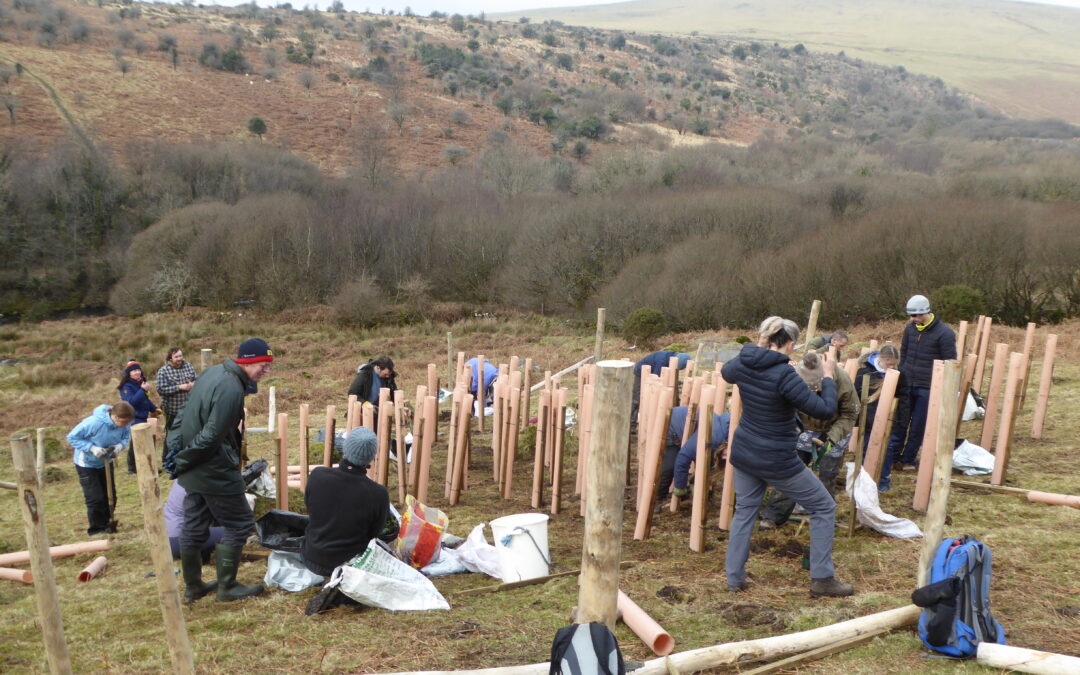
Planting has begun on Harford Moor as part of a pioneering trial aiming to boost flood resilience and help re-establish Dartmoor’s ancient woodland pastures and temperate rainforests. Moor Trees is working closely in partnership with Dartmoor National Park Authority who are leading the Dartmoor Headwaters project, funded by the Environment Agency and Devon County Council. Plus, monitoring and research by the University of Plymouth, led by Moor Trees trustee, Dr Thomas Murphy, aims to better understand which techniques work best to encourage natural woodland regeneration while reducing the peak flow of water during floods and, in the longer term, increase temperate rainforests along Dartmoor’s valleys.
Around 8.5 hectares of native trees will be planted by a team of volunteers led by Moor Trees in small plots. The site and location of the planting has been carefully selected to help to reconnect existing woodlands so nature can thrive and habitats become more resilient to the impacts of climate change now and in the future.
The tree plot trials
The plot planting uses an innovative approach known as the Miyawaki Method named after its developer, Japanese botanist Dr Akira Miyawaki. Widely used in other countries, Dartmoor is thought to be one of the first upland trials of this kind in Europe for the purpose of improving flood resilience.
Harford Moor is owned by the Howell family who are supporting the trial. The Harford and Ugborough Commoners’ Association accepted the tree planting trial designed by the University of Plymouth using data from detailed tree surveys carried out across several commons by Corylus Ecology and Evolving Forests on behalf of Our Upland Commons.
John Howell says: “We have long wanted to restore the relict ageing trees around the fringes of the moor and are delighted that this project has brought all the interest groups together to reach agreement for it to happen. I look forward to nurturing the trees into maturity.”
Richard Drysdale, Dartmoor National Park Authority’s Director for Conservation and Communities, says: “This project is a great demonstration of how we work together and use bold approaches for Dartmoor’s continued protection. This trial has many benefits for habitat creation, woodland connectivity, climate and flood resilience, commoning and grazing practices – it’s a long list and we’re very excited to be involved.”
Philip Metcalf, the Environment Agency’s Flood and Coastal Risk Management Officer and Project Manager for Dartmoor Headwaters, says: “Thanks to the support from all those involved, tree planting on Harford Moor offers a great opportunity for both improving flood resilience to communities downstream and creation of vital habitat. We’re excited to better understand how density of tree planting can improve growth rates for flood risk benefits in our upland environments and how this learning could influence planting techniques elsewhere on the moor.”
Groups of Moor Trees’ volunteers and representatives from the partner organisations will plant the trees throughout February and March using saplings grown in our two community tree nurseries from locally collected seed. We’ll be planting native Devon trees including oak, downy birch, hawthorn and willow in small plots of different tree densities across the site, with some plots fenced off to exclude livestock and also the use of cactus guards to protect more scattered planting.
Helen Aldis, Chief Executive of Moor Trees, says: “Moor Trees is delighted to be supplying local provenance native trees and supervising their planting at this important site on Dartmoor. Integrating more trees into the landscape is of huge importance and while this project delivers improved flooding resilience, it will also increase biodiversity helping to further restore nature through natural regeneration in the coming years.”
Spanning more than 700 hectares, Harford Moor lies to the east of the River Erme near Ivybridge on South Dartmoor. Rich in archaeology and shaped through thousands of years of farming practices and other uses, the upper reaches are rich carbon stores of peat. The ancient and special woodland of nearby Piles Copse is filled with rare lichens, mosses and liverworts.
In its varied landscape, the steeper valley sides are ideal areas for tree regeneration. A more vegetated surface with deeper tree root systems help soak up and slow the water on its journey to the river.
This scheme demonstrates how collective working is fulfilling the ambitions of the Dartmoor Partnership Plan. The plan targets an increase of 500 hectares of native woodland growth along river valleys while increasing shelter and shade for livestock, and diversifying habitats for wildlife.
This trial forms part of the wider programme of work supported by Our Common Cause: Our Upland Commons, which concludes in March 2025 having shown that common land is vital for nature, livestock production, cultural heritage, climate action, and recreation and access.
If you’d like to get involved in a tree planting day at Harford please sign up via our Eventbrite page


