

A new report from the Woodland Trust, HTA, National Trust and RHS highlights the significant effort that goes into producing trees. The challenges that all tree growers experience, irrespective of size, are laid bare in this clear and helpful report. As a charity that runs two Community Tree Nurseries we know all too well the highs, lows and hard graft (no pun intended!) of tree production. You can read the Strong Roots report here.
Each year we embark upon our annual programme of seed gathering which for the past three years has been sponsored by the Woodland Trust. We also benefit from the generosity of local landowners who welcome us to gather seeds, nuts and fruit from their woodlands. Many of these are ancient woodlands and some Sites of Special Scientific Interest so we also need to gain consent from Natural England before we even step foot (in our clean boots) into these habitats.
For many of our volunteers and the team this is a joyful time in the Moor Trees calendar – we get to visit some incredible places on and around Dartmoor. Just being in a woodland opens our eyes to the wonder of these sites and the range of conversations between us is extraordinary. Razor sharp eyes seek out acorns, berries and nuts while the more inquisitive are spotting signs of mammals, species of fungi and a particular bird call. It is an important time to remind ourselves why we do what we do and its importance for the future landscape of Dartmoor.

Volunteers gathered around a Hawthorn tree at Emsworthy Mire on Dartmoor, collecting berries
Moor Trees is dedicated to restoring native woodland on Dartmoor. For us to create the healthy, resilient woodlands we want to see we value the importance of using local provenance trees as much as possible. By capitalising on the genetics found in the woodlands over centuries of adaptation we understand that the habitats we create will be pre-connected and familiar to the environment they are growing in. This is particularly important when we are working to restore and expand ancient woodlands and special places such as Wistman’s Wood – a fragment of temperate rainforest.
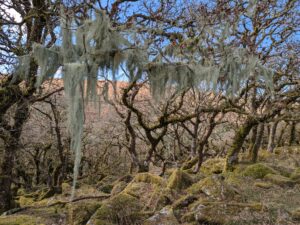
Lichen dripping from the trees in Wistman’s Wood
All producers share the same frustrations around seed supply. We are reliant on nature’s ability to provide which leads to annual fluctuations in quantities and quality of seeds that we can gather ourselves.
Another finding from the report is that it is difficult to forecast demand which in turn means limitations to fulfilling customer need in the future. Unexpected changes to funding with tree planting grants being removed or delayed are a key contributor to this, but so too is access to information on pipeline projects. This is one reason last month we chaired a meeting in partnership with the Woodland Trust to explore the future demand for tree supply on Dartmoor with a range of key stakeholders and representatives from our three Landscape Recovery projects in attendance. Local tree supply planning must also be a key factor in the implementation of the Devon Tree Strategy.
But, back at the nurseries with this year’s haul of seeds is the start of a process of production which is time consuming, on occasion labour intensive and also overseen by a range of regulatory requirements that can hold back more communities from wanting to get stuck into their own local production of trees. For us to continue to produce trees we face an ongoing stream of financial and regulatory hurdles that can limit or certainly slow down the potential of expansion. A challenge shared by other Community Tree Nurseries.

Volunteers processing seeds at Moor Trees’ Dartington Community Tree Nursery (c) Josh Greet
This is why we are so pleased to see recognition in this new report of the support that Community Tree Nurseries (CTNs) could benefit from. As well as continued access to capital grants and other funding support the sector also needs a practical approach to regulatory compliance for community growers. Moor Trees has been involved from the get go with the Community Tree Nursery Collaborative. As a founding member of the core group this network provides valuable peer support, mostly online, with occasional visits to learn from each other. The report calls for ongoing investment to enhance training, mentoring and peer support, helping CTNs produce more trees. Proposed funding includes £100,000 annually for the Community Tree Nursery Collaborative (UK).
As our nurseries are a buzz with seed processing, potting acorns, shifting around stock and preparing for thousands of trees to leave us to their new woodland homes over the winter we remain grateful for the hundreds of hours that our volunteers give to support our tree production efforts. We also couldn’t do what we do without our partners, customers and the funders who support our ongoing costs. Thank you.
Main photo credit: Josh Greet www.joshgreet.co.uk


