
Article by Dr Thomas Murphy
At the end of last year, 137 global leaders committed to halt deforestation in the Glasgow COP26 Declaration on Forest and Land Use (ukcop26.org). The declaration aims to halt global forest loss by 2030 and has outlined a clear strategy for the protection of important forest areas, such as the Amazon Rainforest, in what the UN has declared the ‘Decade on Restoration’ (decadeonrestoration.org). However, many observers and members of the public might not be aware that the UK has its own threatened native rainforests even rarer than their tropical counterparts, many of which exist in upland areas like Dartmoor.
These native ‘temperate rainforests’ can be found along the oceanic edges and, typically, upland areas (>250m), generally in the north and west of the UK. Temperate rainforests occur where rainfall is high (> 1400 - 1500mm annual precipitation), steady (>10% of annual precipitation occurs in summer), and where mean daily and annual temperature fluctuations are low (Ellis et al., 2016; Bain 2015; Alaback, 1991). Suitable conditions for these rainforests occur on less than 1% of global land area. The British Isles contains up to 40% of the suitable land area within Europe (DellaSala, 2011).

Example of Atlantic oak woodland on Dartmoor.
Like their tropical equivalents, our native temperate rainforests are rich in plant diversity. In particular, they are characterised by the verdant growth of epiphytic bryophytes (mosses and liverworts), lichens and ferns, which festoon the stems and canopies of trees and carpet the ground in a luxuriant ‘living’ blanket. It is estimated that British and Irish rainforests may have one of the richest bryophyte flora’s in the world, with Britain alone home to 65% of all Europe’s Bryophyte species (Ratcliffe 1968; Rothero 2005).
Restoring Forgotten Rainforests – the Importance of Atlantic Oak and Other Native Species
Britain’s ‘Atlantic’ oak woodland temperate rainforests (Baarda et al 2006), provide a habitat for a number of rare and protected lichens, plants, birds and insects, including the rare Horsehair Lichen (Bryoria smithii), Prickly Featherwort (Plagiochila spinulosa), Pied Flycatcher (Ficedula hypoleuca), Redstart (Phoenicurus phoenicurus), and the enigmatic Blue Ground Beetle (Carabus intricatus). These woodlands are characterised by a dominance of oak, typically, but not exclusively, Sessile Oak (Quercus Petraea), with other tree species present, including Downy Birch (Betula pubescens), Holly (Ilex aquifolium), Rowan (Sorbus aucuparia) and Willow species (Salix spp). Pollen records suggest these woodlands would have dominated upland areas in the past but, with progressive clearance by humans largely since the late Neolithic (6000 before present), now only cover a fragment of their former extent (Fyfe et al., 2014). They typically occurred where species that prefer poor acid grassland habitats (such as NVC U3 – U4 grassland) are dominant today. Just 70,000 - 100,000ha of this woodland type remain in the UK (Baarda 2005). While the available bioclimatic zone suitable for temperate rainforests (such as Atlantic oak woods) covers 20.8% of UK land surface, the actual fragments of this woodland type is now vanishingly small. To give you an idea, within Dartmoor National Park, semi-natural oak woodland covers just 4% of land area (Dartmoor.gov.uk).
Even more alarmingly, across their range, these remaining fragments face numerous threats, including over-grazing by sheep and deer, invasion by alien and invasive species such as Rhododendron (Rhododendron ponticum) and Cherry Laurel (Prunus laurocerasus), and decline and pathogen attacks exacerbated by accelerating anthropogenic climate change. To borrow a phrase from Sir John Lawton (2010), there has never been a more important time to ensure these woodlands are ‘bigger, better and more joined up’ to ensure their future resilience. Connecting these woodlands would help increase genetic flow of species and build the capacity for both present and future flora and fauna to move and adapt in a changing climate.
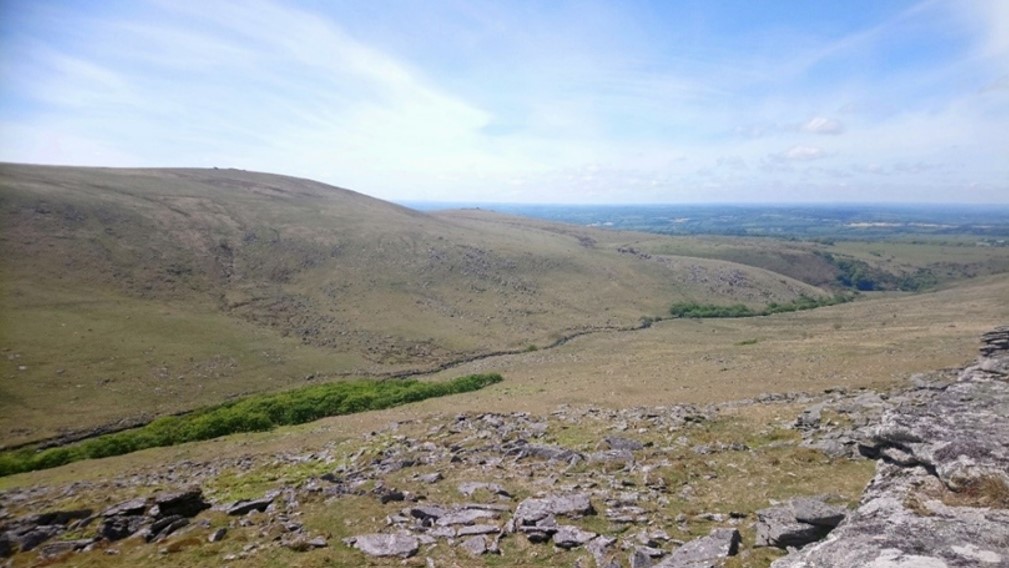
Slither of upland ‘Atlantic’ oak woodland at Black-a-Tor Copse in north west Dartmoor.
The Impact of Restoring Forgotten Rainforests on Climate Change
Our globally significant woodland habitats are worth protecting for more than just the sake of our heritage – their expansion might offer a ‘nature-based solution’ to help mitigate the damaging effects of climate change. Research from the University of Plymouth, supported by Moor Trees and in partnership with the UK Environment Agency, has shown that the early establishment of these woodlands can transform soil health and restore the hydrological functioning of soils in just a few years (Murphy et al., 2021). Helping the expansion of these woodlands could therefore help alleviate the elevated downstream flood risk that is increasingly experienced with the climate change-driven alteration in rainfall experienced in upland areas (Murphy et al., 2019).
There is also potential for these forests to provide a net gain in carbon removal from the atmosphere, if supported in the right areas. Oak trees are ‘long lived pioneers’ and may lock up carbon for 1000 years or more. These woodlands typically establish on steeper slopes, distinct from the deepest, most carbon-rich soils, so could complement rather than compete with important carbon-rich habitats such as heath, blanket bog and valley mire, if sensitively encouraged.
Connecting these woodlands could also support the re-introduction of charismatic and functional animal species, which is increasingly suggested to help restore natural processes and reverse the declining nature conservation outcomes experienced over the last 50 years. The restoration of these Atlantic oak woodland habitats could spark a revival for British wildlife, not to mention their significant societal and community benefits.
How these woodlands can be effectively and sensitively connected and expanded, however, remains a critical question. Where is planting needed and which conditions might help facilitate natural establishment? These questions are particularly pertinent given many of these areas are extensively grazed uplands, often dominated by ‘common land’ that has existing and long-held rights to graze livestock. These areas are also characterised by low tree cover with no easy source of seed for their natural expansion.
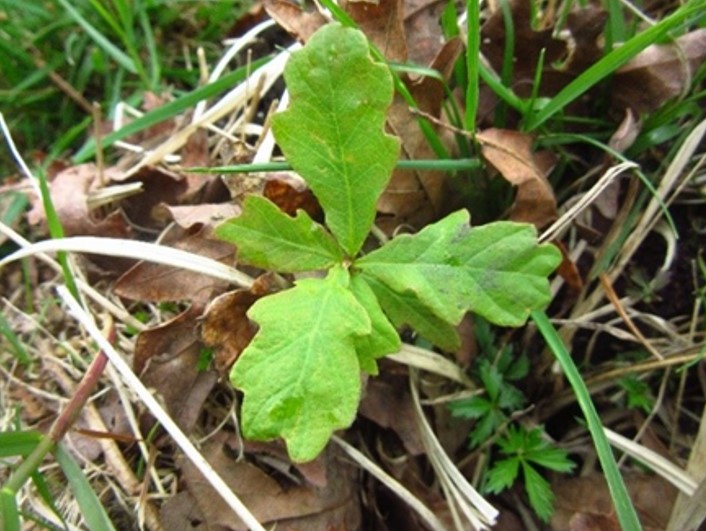
Oak seedling naturally establishing in Dartmoor’s extensive pastoral landscape.
Evidence from some soon-to-be-published research on Dartmoor (Murphy et al., 2022) suggests expansion distances (of oak in particular) is severely limited in scope, with targeted planting likely required. Findings also suggest that, while temporary protection of recently established trees from grazing livestock will be critical to their development, grazing, if managed correctly, could actually be of benefit to the initial establishment of these Atlantic oak woodlands.
What seems clear is that considerable effort from multiple parties working in partnership together will be required to expand and connect existing fragments of woodland and make our forgotten rainforests resilient in the future. Understanding how to best expand these woodlands would help policy makers prioritise incentives and land managers focus interventions. With the right will and financial support in place, upland farms and local grazers could be the best ally in helping restore and expand these critically endangered, invaluable woodlands.
A whitepaper on oak regeneration in the UK’s uplands, and supportive research can be accessed via www.Treesforclimatenow.com
To find out more about the work Moor Trees is doing across Dartmoor and South Devon to help restore our forgotten rainforests, grow, plant and expand areas of native broadleaf woodland, improve the environment, increase biodiversity, and connect people with their forest heritage, please explore our ‘New Vision for Dartmoor’.
References
Alaback PB (1991) Comparative ecology of temperate rainforests of the Americas along analogous climatic gradients. Revista Chilena de Historia Natural, 64: 399–412.
Baarda P (2005) Atlantic oak woods in Great Britain: factors influencing their definition, distribution and occurrence. Botanical Journal of Scotland, 57: 1–20. https://doi.org/10.1080/03746600508685082
Bain C (2015) The Rainforests of Britain and Ireland. Sandstone Press Ltd, Dingwall.
Dartmoor.gov.uk - https://www.dartmoor.gov.uk/wildlife-and-heritage/habitats2/woodland/upland-oakwood
DellaSala DA (2011) Temperate and Boreal Rainforests of the World: Ecology and Conservation. Island Press, Washington.
Ellis CJ (2016) Oceanic and temperate rainforest climates and their epiphyte indicators in Britain. Ecological Indicators, 70: 125 – 133. https://doi.org/10.1016/j.ecolind.2016.06.002
Fyfe et al. (2014). From forest to farmland: pollen?inferred land cover change across Europe using the pseudobiomisation approach. Global Change Biology, 21: 1197-1212. https://doiorg.plymouth.idm.oclc.org/10.1111/gcb.12776.
Lawton et al. (2010) Making Space for Nature: a review of England’s wildlife sites and ecological network. Report to Defra.
Murphy et al. (2019) Deviation between projected and observed precipitation trends greater with altitude. Climate Research 79: 77-89. https://doi.org/10.3354/cr01583
Murphy et al. (2021) Native woodland establishment improves soil hydrological functioning in UK upland pastoral catchments. Land Degradation & Development. https://doi.org/10.1002/ldr.3762 (Open Access).
Murphy et al. (2022) Optimising opportunities for oak woodland expansion into upland pastures. Ecological Solutions and Evidence. DOI: 10.1002/2688-8319.12126. https://besjournals.onlinelibrary.wiley.com/doi/10.1002/2688-8319.12126
Ratcliffe DA (1968) An ecological account of Atlantic bryophytes in the British Isles. New Phytologist, 67: 365 – 439. https://doi.org/10.1111/j.1469-8137.1968.tb06392.x
Ukcop26.org - https://ukcop26.org/glasgow-leaders-declaration-on-forests-and-land-use/
UN Decade on Restoration - https://www.decadeonrestoration.org/


